

Installing an Over-Mount Sink
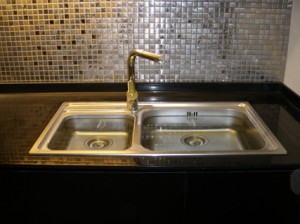
Installing a kitchen sink is an easy Do-It-Yourself project that can significantly change the overall look of one of the most important rooms in your home.
Time: No more than half a day
Price Range: $250-$500
Difficulty: Easy
Materials:
• plumber’s putty
• sink
• garbage disposal unit
• sink mounting clips
• silicone caulk
• strainer assembly
Step 1: Position and Cut the New Sink Opening
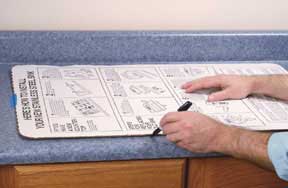
Place the sink cut-out template on the countertop, where the sink is to be installed. Trace around the outside perimeter with a pencil. When tracing the sink opening, set it back at least 1-1/2″ from the front edge of t
he countertop. If the countertop is wider (front to back) than 24″, leave more than 1-1/2″ to retain strength at the front edge, but no more than 3″ to 4″.
After tracing, remove the template. Use a straightedge if necessary to straighten out the traced outline. Use a drill with a 7/8″ spade bit to drill four pilot holes, one in each corner inside the outline. These holes will be your starting points for sawing the hole, so they must be large enough to fit the blade of a jig saw or keyhole saw.
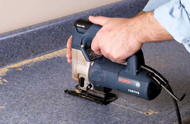
Cut the hole for the sink, using a jig saw to cut along the outline between each hole. Because the rim of the sink will cover the sawed edges, it’s important to follow the line but not crucial for the edges to be perfectly straight. If you don’t have a jigsaw, a keyhole saw will work just as well for both curved and straight cuts.
Step 2: Prep the New Sink
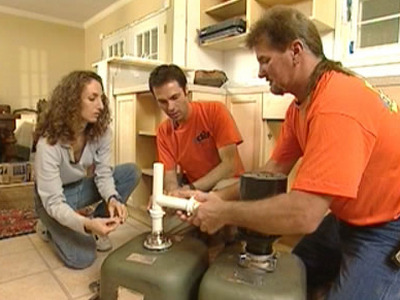
Before installing the sink, place a bead of plumbers putty along the edge of the drain opening inside the sink and press the strainer body into place. Turn the sink upside down and tighten the strainer locknut with a wrench. While tightening, hold the strainer steady with pliers the keep it from turning. Wipe away any excess plumber’s putty.
Fit the gasket
on the sink drain pipe (tailpiece) and attach it to the strainer bottom with a slip nut. Tighten this nut by hand. For most threaded connections, apply a sealant such as plumbers putty, silicone tape or “pipe dope” to the threads to ensure a watertight connection.
If a garbage disposal will be installed with the sink, attach the unit directly below the drain fitting before installing the tailpiece. In this project, the disposal unit is attached to a second sink bowl. Turn the unit clockwise until it’s securely attached.
Attach the drain pipe assembly that comes with your sink.
Step 3: Install the Sink
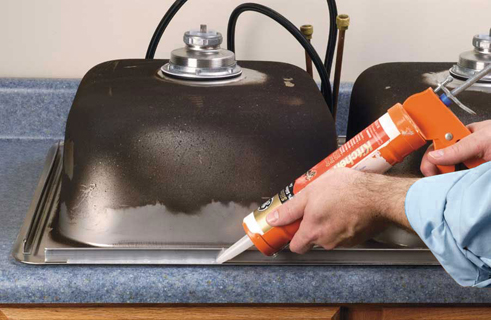
Apply a “rope” of plumbers putty around the perimeter of the underside of the sink or plumbing caulk. Flip the sink over and carefully place it, with all of the drains and attachments secured, into the hole. Press down firmly to seat the sink against the countertop.
Use mounting clips to pull the sink down tight to the countertop. These clips hook onto the sink lip from below the countertop. Tighten with a screwdriver.
After the sink is positioned and securely in place, place plumbers putty around the underside of the faucet body or its mounting plate and install it into the sink. (Image 1 shows recommended mounting clip placement.) (Image 2: Overmount Sink Fastening Detail.)
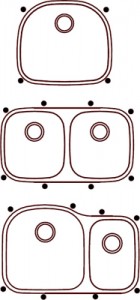
Image 1
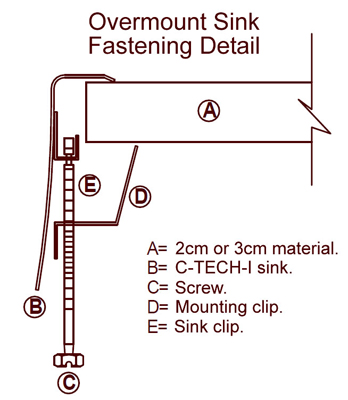
Image 2
Attach all plumbing connections to the house drain line and water supply tubing. Apply a bead of silicone caulking around the perimeter of the sink where it meets the counter to seal any gaps. Fill the sink with water and leave it overnight to add weight and help it settle in place. Afterward, re-tighten the sink clips if necessary.
FOLLOW ALL LOCAL BUILDING AND SAFETY CODES IN YOUR AREA.
THE ABOVE IS ONLY A SUGGESTED METHOD TO BE PREFORMED AT YOUR
OWN RISK. REFER TO OSHA FOR PROPER SAFETY PRACTICES.

 Facebook
 Google+
 Email Us
 YouTube