

Kitchen Sink Mounting Styles
There are two mounting choices to consider when selecting your kitchen sink: self-rimming sinks and undermount kitchen sinks. Both have their benefits, and the choice is really just a matter of taste and function; you’ll want to determine which one will work best for you.
Overmount/Self-Rimming Sinks
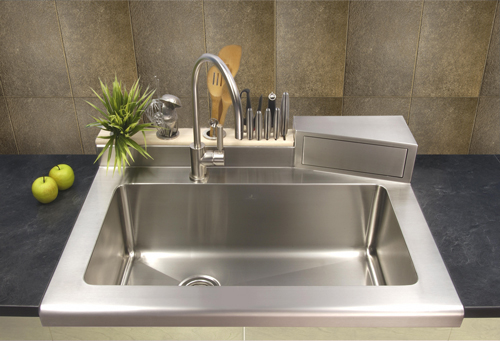
Self-rimming sinks have a finished edge and are installed onto the countertop. These are the easiest sinks to install, and they are easy to replace; however, they can also collect dirt at the seams. There are no restrictions on the counter-top material when you use self-rimming sinks.
Undermount Sinks

Kitchen Sink Materials
Stainless Steel
Stainless steel kitchen sinks are made to last. Stainless kitchen sinks are the most used home kitchen sinks and commercial sinks because they offer quality, durability, a low price and ease of cleaning. Stainless steel kitchen sinks won’t be damaged by hot or cold objects and resist damage caused by impacts.
One disadvantage of a stainless steel kitchen sink is that they tend to be noisier than most other sink materials due to the stainless steel being thin (although better sinks apply a heavy coating of vibration-damping material to the underside of the sink).
Most stainless steel kitchen sinks are made with a die. A sheet of stainless steel is drawn over the die then pressed. (Some very deep sinks are fabricated by welding.) Look for the highest-grade stainless, which is known as Type 302, or 18/8. This grade of steel contains 18-percent chromium and 8-percent nickel for a durable, rust-resistant finish. Also, look at the gauge, or thickness, of the stainless steel kitchen sink. With stainless steel sinks, the heavier the gauge, the better; the lower the gauge number, the thicker the steel. A thicker sink is less likely to dent and it won’t be as noisy as a thinner stainless kitchen sink. Most sinks come in 18 to 20 gauge; sinks in 14 and 16 gauge steel are available on the high end as well as 24 gauge steel on the lower end.
Granite Composite
These are the most durable sinks on the market today. The high density of rock particles at the sink’s surface cause this kitchen sink to be scratch-, chip- and heat-resistant. Hot pans will not mar the surface since these sinks offer heat resistance to 535? F.
Quartz Composite
Quartz composite kitchen sinks are a step below granite composite when it comes to their durability and wear. Quartz composite is usually a combination of 70-percent quartz and 30-percent resin filler. Quartz composite kitchen sinks can resist everyday cuts, scuffs and dents. These sinks can easily stand up to harsh cleaning materials and liquids. Quartz composite sinks are available in a variety of colors, and since the color is uniform throughout, this kitchen sink will never lose its original color. This sink is heat-resistant up to 446? F, and pots and pans can usually go right from stove to sink without damaging the sink. # Soapstone: Soapstone is a popular, high-end sink. Soapstone sinks are created by joining slabs of soapstone with epoxy to form the sink basin. The only drawback seems to be the perfectly flat bottom. Anything on the bottom of the sink, such as crumbs, must be manually swept toward the drain. Soapstone is stylish and ages wonderfully.

 Facebook
 Google+
 Email Us
 YouTube